Every election cycle, investors find themselves asking similar questions: What will happen to the stock market if Democrats win? What if Republicans take control? Should I make changes to my investments based on the election results?
These are understandable questions, particularly when political headlines dominate the news. However, the stock market isn't Republican or Democratic. While government policies can influence the economy, market performance is driven by many factors, including corporate earnings, interest rates, consumer spending, and expectations about the future.
The market doesn't necessarily care which political party introduces a policy. What matters is how that policy may affect businesses, consumers, and future profitability.
Markets Have Performed Well Under Both Parties
Historically, the S&P 500 Index has performed well under both Democratic and Republican administrations.
An analysis by D.A. Davidson examining S&P 500 performance from 1945 through 2025, a period beginning just after World War II, found the following average annual price returns:
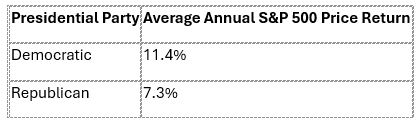
Source: D.A. Davidson, Midterms & Markets: A Long-Term Look at Political Cycles. Returns reflect historical S&P 500 Index price performance, excluding dividends, and do not represent the performance of portfolios managed by The Dala Group. Past performance does not guarantee future results.
At first glance, these numbers might suggest that one political party is better for investors, but there is more to consider.
Presidents often receive too much credit when markets rise and too much blame when they fall. They inherit economic conditions from previous administrations and face events outside their control, including recessions, inflation, global conflicts, and technological changes.
While government policies certainly matter, presidential affiliation alone is not a reliable predictor of future stock market returns. History has shown that markets can perform well under either party.
The Market Looks Forward, Not Backward
One of the most important things to understand about the stock market is that it doesn't simply reflect how the economy is doing today. It also reflects what investors expect to happen in the future.
This helps explain why markets sometimes react in unexpected ways.
For example, rising unemployment or slowing economic growth might sound like bad news for stocks. But if investors believe those conditions will encourage the Federal Reserve to lower interest rates, markets could actually rise.
Conversely, strong economic data can sometimes cause stocks to decline if investors believe interest rates will remain elevated.
Because markets are forward-looking, much of the economic and political news we hear today may already be reflected in stock prices. This is one reason making investment changes based on headlines can be difficult. By the time news becomes widely known, investors may have already adjusted their expectations.
Elections, Uncertainty, and Market Volatility
Elections introduce uncertainty as investors consider how potential changes to taxes, regulations, government spending, and trade policies might affect businesses.
Markets have sometimes rallied following elections regardless of which party wins. One possible explanation is that investors appreciate having greater clarity about the direction of future policy.
Historical seasonal patterns are also worth considering, particularly as we approach November.
September has traditionally been one of the weaker months for U.S. stocks, while October is known for heightened volatility. November and December, on the other hand, have historically been among the stronger months.
Midterm election years have also produced some interesting results. Historical market research has found that November has frequently delivered positive returns during midterm election years. However, these observations depend on the index, time period, and method used to calculate returns.
Of course, historical patterns aren't guarantees. A strong historical track record for November doesn't mean stocks will rise this November, just as a historically weak September doesn't mean investors should sell before Labor Day.
These patterns can provide useful historical context, but they aren't a reason to change an investment strategy designed around your long-term financial goals.
The Bottom Line
Over the decades, the United States has experienced Democratic presidents, Republican presidents, divided governments, recessions, wars, inflation, financial crises, and periods of significant economic growth.
Throughout those changes, businesses have continued adapting, and the stock market has provided opportunities for long-term investors.
That doesn't mean every year will be positive or that government policy is irrelevant. Political decisions can affect individual industries, businesses, and the broader economy, sometimes significantly.
However, making investment decisions based primarily on which political party is in office can lead investors to react to short-term developments rather than focus on their long-term financial needs.
Your investment strategy should reflect your financial goals, time horizon, risk tolerance, and income needs. Those considerations generally matter much more to your long-term financial success than the outcome of any one election.